
Trenutno imamo opise samo na engleskom jeziku.
Advazorb - Absorbent Foam Dressing with Film Backing
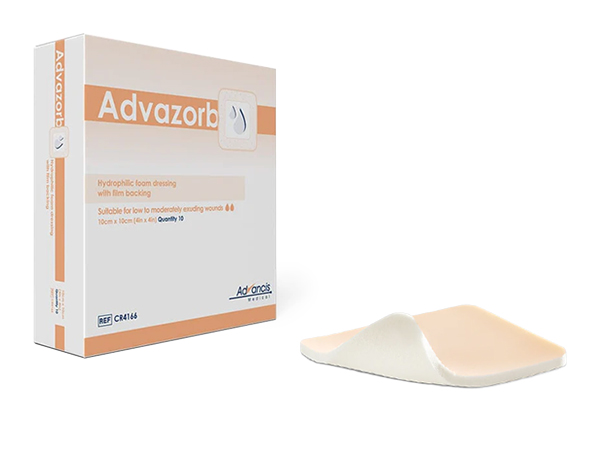
Advazorb is a soft and conformable, low-adherent, hydrophilic, polyurethane foam dressing with a breathable film backing.
A non-adherent foam dressing with excellent fluid handling properties, Advazorb is suitable for wounds with low to medium levels of exudate and is ideal for use under compression bandaging with its fluid retention, low profile and low friction film backing.
The Advazorb range features a waterproof film backing that prevents strike-through. The backing has been designed to reduce friction on clothes and bandages which extends dressing wear time by reducing ‘rucking’ and preventing dressings falling off.
With a high MVTR the Advazorb foam range provides the ideal conditions for wound healing.
A non-adherent foam dressing with excellent fluid handling properties, Advazorb is suitable for wounds with low to medium levels of exudate and is ideal for use under compression bandaging with its fluid retention, low profile and low friction film backing.
The Advazorb range features a waterproof film backing that prevents strike-through. The backing has been designed to reduce friction on clothes and bandages which extends dressing wear time by reducing ‘rucking’ and preventing dressings falling off.
With a high MVTR the Advazorb foam range provides the ideal conditions for wound healing.
Indications:
Suitable for a wide range of exuding wounds, granulating wounds, leg ulcers, pressure sores and for protection of bony prominences.
Instructions for Use:
- Ensure the area has been cleaned
- Gently dry the surrounding skin
- Apply advazorb directly to the wound surface pink film side up
- Secure in place with tape, appropriate bandage or secondary dressing
- Store at room temperature, out of direct sunlight and keep dry
Frequency of change:
Advazorb can be left in place for up to 7 days
Advazorb can be left in place for up to 7 days
Suitable for the following wound types: sloughy, granulating, epithelialising
Available sizes: 5cm x 5cm, 7.5cm x 7.5cm, 10cm x 10cm, 12.5cm x 12.5cm, 15cm x 15cm, 10cm x 20cm, 20cm x 20cm
Activon Tube - 100% Manuka Honey

Activon Tube is ideal for debriding necrotic tissue, or for topping up dressings where the honey has been washed away by exudate.
Activon Tube contains 100% medical-grade Manuka honey which creates a moist healing environment and effectively eliminates wound odour whilst providing antibacterial action. Conveniently presented as a 20g tube, Activon Tube can be used for 90 days once opened.
Activon Tube is one of the best value 100% Manuka Honey products available¹, and therefore a sensible choice for cost savings.
Activon Tube contains 100% medical-grade Manuka honey which creates a moist healing environment and effectively eliminates wound odour whilst providing antibacterial action. Conveniently presented as a 20g tube, Activon Tube can be used for 90 days once opened.
Activon Tube is one of the best value 100% Manuka Honey products available¹, and therefore a sensible choice for cost savings.
Indications:
For use on Activon honey impregnated wound dressings or as a wound filler, directly onto the wound bed, for partial or full thickness wounds including:
For use on Activon honey impregnated wound dressings or as a wound filler, directly onto the wound bed, for partial or full thickness wounds including:
- Sloughy wounds
- Pressure ulcers
- Surgical wounds
- Burns
- Graft sites
- Malodorous wounds.
Contra-indications:
Known allergy to bee-venom/honey.
Known allergy to bee-venom/honey.
Instructions for Use:
- Ensure the wound has been cleaned
- Gently dry the surrounding skin
- Remove the sterile tube from the box.
- Twist off the cap
- Apply liberally to the wound bed (surface or cavity)
- Cover with an appropriate secondary dressing.
- Single patient use only
- Store at room temperature
- Once opened use within 90 days
Initially you may experience high levels of exudate, this is perfectly normal and will decrease over time, therefore your secondary dressing of choice may initially need to be a superabsorbent dressing, we recommend Eclypse.
Top tip: Use Activon Tube in conjunction with Algivon for debriding and de-sloughing.
Suitable for the following wound types: necrotic, sloughy, cavity, infected
Available sizes: 20 g
Activon Tulle - 100% Manuka Honey
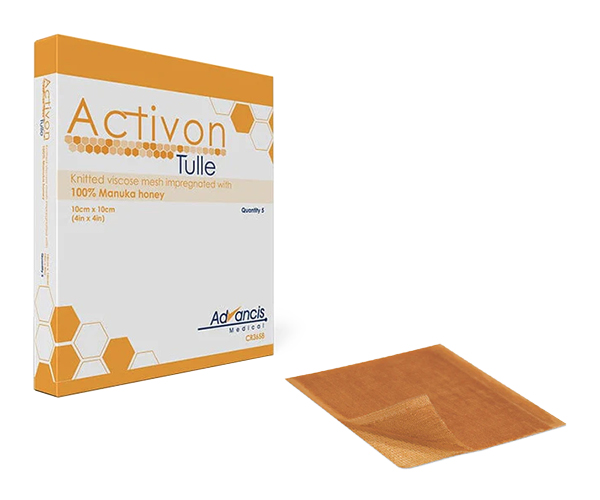
Activon Tulle is a knitted viscose mesh primary dressing impregnated with 100% Medical Grade Manuka honey to create a moist healing environment and effectively eliminate wound odour whilst providing antibacterial action. The mesh material is conformable and non-adherent, allowing good wound coverage while reducing pain and trauma on dressing change.
Activon Tulle is ideally suited to debriding and de-sloughing necrotic wounds to create an optimal healing environment.
Available in a variety of different sizes, Activon Tulle is designed to effectively cover wounds of all sizes.
Activon Tulle is ideally suited to debriding and de-sloughing necrotic wounds to create an optimal healing environment.
Available in a variety of different sizes, Activon Tulle is designed to effectively cover wounds of all sizes.
Indications:
May be used on all wound types including:
- Superficial wounds, partial or full thickness wounds, e.g. cuts and abrasions
- Pressure ulcers
- Leg ulcers
- Surgical wounds
- Burns
- Infected wounds
- Graft & donor sites
May assist with debridement if used in conjunction with Activon Tube.
Contra-indications:
Do not use if patient is allergic to bee venom, bee products or essential oils.
Activon Tulle contains glucose. Monitor the levels of patients with diabetes.
A few patients experience pain when applied, depending on sensitivity of the wound it may be necessary to consider an appropriate level of analgesia. If pain continues unabated, discontinue use and irrigate the wound with saline solution.
Do not use if patient is allergic to bee venom, bee products or essential oils.
Activon Tulle contains glucose. Monitor the levels of patients with diabetes.
A few patients experience pain when applied, depending on sensitivity of the wound it may be necessary to consider an appropriate level of analgesia. If pain continues unabated, discontinue use and irrigate the wound with saline solution.
Instructions for Use:
- Ensure the wound has been cleaned
- Gently dry the surrounding skin
- Remove from packaging
- Place (either side down) onto the wound surface
- Dressings can be placed side-by-side to cover large wound areas, or cut to size for smaller areas.
- Activon Tulle can be unfolded to cover larger areas (this reduces the concentration of honey at the wound site)
- Cover with an appropriate secondary dressing.
- Store at room temperature
Frequency of Change:
Depending on wound exudate levels, any surrounding interstitial fluid, oedema and dressing regimen may require changing daily but can be left in place for up to 7 days. Will be less effective when diluted by wound exudate. To maintain an effective honey level, change the dressing when the colour changes significantly.
Due to the nature of honey, it can solidify at cold temperatures and become more malleable at warmer temperatures. If the product has hardened, warm between hands to soften before use. If the product has become too soft, place in a colder place such as a fridge for a few minutes.
Depending on wound exudate levels, any surrounding interstitial fluid, oedema and dressing regimen may require changing daily but can be left in place for up to 7 days. Will be less effective when diluted by wound exudate. To maintain an effective honey level, change the dressing when the colour changes significantly.
Due to the nature of honey, it can solidify at cold temperatures and become more malleable at warmer temperatures. If the product has hardened, warm between hands to soften before use. If the product has become too soft, place in a colder place such as a fridge for a few minutes.
Top tip: Activon Tulle is a triple layer knitted viscose net dressing which can be unfolded to decrease the amount of honey if discomfort is being experienced by the patient. Algivon releases honey at a slower rate into the wound therefore may be a solution if discomfort is being experienced by the patient when using Activon Tulle.
Suitable for the following wound types: necrotic, infected
Available sizes: 5cm x 5cm, 10cm x 10cm
Actilite - 100% Manuka Honey

Actilite is a light, viscose net dressing, coated with 99% Manuka honey & 1% Manuka oil. This Manuka honey dressing is designed to protect the wound, promote healing and allow the passage of exudate.
The antibacterial effect of Actilite has been enhanced by combining high grade antibacterial Manuka oil with Manuka honey. The combination of Manuka honey and Manuka oil has been demonstrated in-vitro to be effective against a number of major wound infecting organisms including MRSA, VRE and Providentia stuartii.
Manuka oil also helps scars and after marks on the skin fade away by promoting new cell growth.
Actilite is ideal for granulating and epithelialising wounds ensuring moisture levels remain low to avoid maceration while still providing a moist wound environment optimal for healing.
Available in six different sizes, Actilite is designed to effectively cover wounds of all sizes.
The antibacterial effect of Actilite has been enhanced by combining high grade antibacterial Manuka oil with Manuka honey. The combination of Manuka honey and Manuka oil has been demonstrated in-vitro to be effective against a number of major wound infecting organisms including MRSA, VRE and Providentia stuartii.
Manuka oil also helps scars and after marks on the skin fade away by promoting new cell growth.
Actilite is ideal for granulating and epithelialising wounds ensuring moisture levels remain low to avoid maceration while still providing a moist wound environment optimal for healing.
Available in six different sizes, Actilite is designed to effectively cover wounds of all sizes.
Indications:
May be used on all wound types including:
- Superficial wounds, partial or full thickness wounds, e.g. cuts and abrasions
- Pressure ulcers
- Leg ulcers
- Surgical wounds
- Burns
- Infected wounds
- Graft & donor sites.
May assist with debridement if used in conjunction with Activon Tube.
Contra-indications:
Do not use if patient is allergic to bee venom, bee products or essential oils. Actilite contains glucose. Monitor the levels of patients with diabetes. A few patients experience pain when applied, depending on sensitivity of the wound it may be necessary to consider an appropriate level of analgesia. If pain continues unabated, discontinue use and irrigate the wound with saline solution.
Do not use if patient is allergic to bee venom, bee products or essential oils. Actilite contains glucose. Monitor the levels of patients with diabetes. A few patients experience pain when applied, depending on sensitivity of the wound it may be necessary to consider an appropriate level of analgesia. If pain continues unabated, discontinue use and irrigate the wound with saline solution.
Warnings and Precautions:
Actilite® is a single use product. If used on more than one patient, cross-contamination or infection may result. Opening the dressing pack compromises the sterile barrier.
Any unused dressings should be discarded.
Actilite® is a single use product. If used on more than one patient, cross-contamination or infection may result. Opening the dressing pack compromises the sterile barrier.
Any unused dressings should be discarded.
Instructions for Use:
- Ensure the wound has been cleaned
- Gently dry the surrounding skin
- Remove from packaging
- Place (either side down) onto the wound surface
- Dressings can be placed side-by-side to cover large wound areas, or cut to size for smaller areas.
- Cover with an appropriate secondary dressing.
- Store at room temperature
Frequency of change:
Depending on clinical observation, dressing may be left in place for up to 7 days. Actilite will be less effective as the honey is diluted by wound exudates, to maintain an effective level change the dressing when the colour changes significantly.
Due to the nature of honey, it can solidify at cold temperatures and become more malleable at warmer temperatures. If the product has hardened, warm between hands to soften before use. If the product has become too soft, place in a colder place such as a fridge for a few minutes.
Depending on clinical observation, dressing may be left in place for up to 7 days. Actilite will be less effective as the honey is diluted by wound exudates, to maintain an effective level change the dressing when the colour changes significantly.
Due to the nature of honey, it can solidify at cold temperatures and become more malleable at warmer temperatures. If the product has hardened, warm between hands to soften before use. If the product has become too soft, place in a colder place such as a fridge for a few minutes.
Suitable for the following wound types: epithelialising, granulating, fungating, infected
Available sizes: 5cm x 5cm, 10cm x 10cm, 10cm x 20cm, 20cm x 30cm, 30cm x 30cm, 30cm x 60cm
Algivon Plus - 100% Manuka Honey
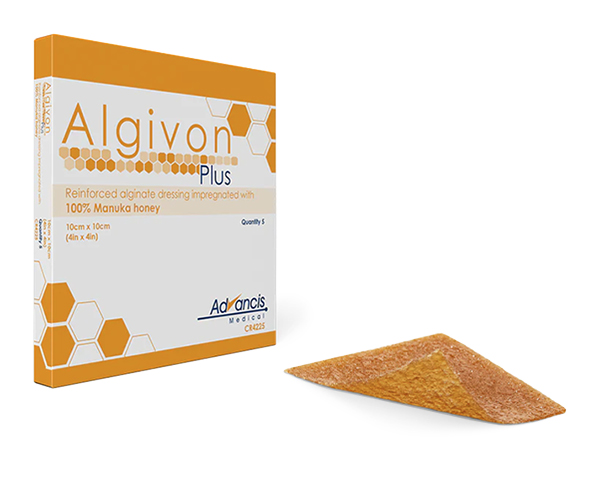
Algivon Plus is a soft alginate dressing impregnated with 100% medical grade Manuka honey. This Manuka honey dressing has reinforced alginate fibres enabling a sustained, slow release of honey whilst maintaining the integrity of the dressing. This creates a moist healing environment and effectively eliminates wound odour whilst providing antibacterial action.
Algivon Plus is an ideal choice for wetter wounds as the alginate has a small capacity to absorb, meaning the honey isn't washed away with exudate therefore staying at the wound site for longer.
The dressing is very soft and conformable, ideal for debriding and de-sloughing large areas of sloughy tissue.
Available in two different sizes and with easy-release liners, Algivon Plus is designed for-ease-of-use and to effectively cover wounds of all sizes.
Algivon Plus is an ideal choice for wetter wounds as the alginate has a small capacity to absorb, meaning the honey isn't washed away with exudate therefore staying at the wound site for longer.
The dressing is very soft and conformable, ideal for debriding and de-sloughing large areas of sloughy tissue.
Available in two different sizes and with easy-release liners, Algivon Plus is designed for-ease-of-use and to effectively cover wounds of all sizes.
Indications:
Algivon Plus may be applied to any wound but especially:
Algivon Plus may be applied to any wound but especially:
- Pressure ulcers,
- Leg ulcers,
- Diabetic ulcers,
- Surgical wounds,
- Burns,
- Graft sites
- Infected wounds.
Contra-indications:
Do not use if patient has a known allergy to bee-venom/honey.
Do not use if patient has a known allergy to bee-venom/honey.
- Instructions for Use:
- Ensure the wound has been cleaned
- Gently dry the surrounding skin
- Remove from packaging
- Place (either side down) onto the wound surface
- Dressings can be placed side-by-side to cover large wound areas, or cut to size for smaller areas.
- Cover with an appropriate secondary dressing.
- Store at room temperature
Frequency of change:
Depending on clinical observation, dressing may be left in place for up to 7 days. Algivon Plus will be less effective as the honey is diluted by wound exudates, to maintain an effective level change the dressing when the colour changes significantly.
Due to the nature of honey, it can solidify at cold temperatures and become more malleable at warmer temperatures. If the product has hardened, warm between hands to soften before use. If the product has become too soft, place in a colder place such as a fridge for a few minutes.
Depending on clinical observation, dressing may be left in place for up to 7 days. Algivon Plus will be less effective as the honey is diluted by wound exudates, to maintain an effective level change the dressing when the colour changes significantly.
Due to the nature of honey, it can solidify at cold temperatures and become more malleable at warmer temperatures. If the product has hardened, warm between hands to soften before use. If the product has become too soft, place in a colder place such as a fridge for a few minutes.
Top tip: Algivon Plus has the capacity to absorb exudate so is ideal for use on wetter wounds.
Suitable for the following wound types: sloughy, infected
Available sizes: 5cm x 5cm, 10cm x 10cm
Made with 100% Medical-Grade Manuka Honey
The levels of MGO in Manuka honey are measured using the Non Peroxide Activity (NPA) scale. The gold standard for Manuka honey effective antimicrobial activity is anywhere between 9.5 and 15 on the NPA scale. All our Activon Manuka honey dressings are made with 100% medical-grade Manuka honey, with a guaranteed NPA of 9.5 – 15 to optimise antimicrobial action and promote faster healing¹.
References:
1. Dunford C, Cooper R, Molan P, White R. (2000) The use of honey in wound management. Nursing Standard, 15, 11, 63-68
1. Dunford C, Cooper R, Molan P, White R. (2000) The use of honey in wound management. Nursing Standard, 15, 11, 63-68
What is Manuka Honey?
Manuka honey is made by bees from nectar gathered from Manuka flowers. The Manuka bush (Leptospermum Scoparium) is native to New Zealand. The Māori people have long prized the plant for its healing properties, using Manuka bark and leaves to treat many conditions, from colds to skin diseases.
The Activon dressing range has been expertly designed to support all stages of wounds healing, from initial presentation to granulation and epitheliasation.
The Activon dressing range has been expertly designed to support all stages of wounds healing, from initial presentation to granulation and epitheliasation.
Manuka Honey and Woundcare
Advancis was the first company to introduce medical-grade Manuka honey to the UK. Since 2004 we have been working with leading clinicians, patients and their carers to develop our wound management solutions, using the latest advances in material technology.
The use of honey in wound management is now well established with many clinicians successfully using medical grade honey products in a variety of wound types. Osmotic effect, high sugar content, low pH and hydrogen peroxide all contribute to honey’s ability to inhibit microbial growth.¹,²
Advancis was the first company to introduce medical-grade Manuka honey to the UK. Since 2004 we have been working with leading clinicians, patients and their carers to develop our wound management solutions, using the latest advances in material technology.
The use of honey in wound management is now well established with many clinicians successfully using medical grade honey products in a variety of wound types. Osmotic effect, high sugar content, low pH and hydrogen peroxide all contribute to honey’s ability to inhibit microbial growth.¹,²
The 5 Main Benefits of Manuka Honey
01 Antimicrobial
Activon Manuka Honey contains high concentrations of Methylglyoxal (MGO)³, a significant antimicrobial component that continues to be effective giving Manuka honey it’s up to 7 day wear time.
02 Facilitates autolysis
Sugar naturally present in honey has the effect of drawing fluid out of the wound bed, known as the osmotic effect. This facilitates autolysis by drawing exudate from the wound removing slough.
Sugar naturally present in honey has the effect of drawing fluid out of the wound bed, known as the osmotic effect. This facilitates autolysis by drawing exudate from the wound removing slough.
03 Promotes granulation and epithelialisation
The osmotic effect also rehydrates devitalised tissue and encourages an outflow of lymph fluid, needed for cell growth and to promote granulation and epithelialisation.
The osmotic effect also rehydrates devitalised tissue and encourages an outflow of lymph fluid, needed for cell growth and to promote granulation and epithelialisation.
04 Reduces Odour
Odour in a wound is often caused by ammonia and other odorous products excreted by bacteria. When honey is introduced, bacteria feeds on the sugar, rather than the wound tissue causing the emitted by-product to become non-odorous lactic acid.
Odour in a wound is often caused by ammonia and other odorous products excreted by bacteria. When honey is introduced, bacteria feeds on the sugar, rather than the wound tissue causing the emitted by-product to become non-odorous lactic acid.
05 Maintains a moist wound healing environment
Activon Manuka Honey helps maintain a moist wound healing environment which can help speed up the wound healing process.
Activon Manuka Honey helps maintain a moist wound healing environment which can help speed up the wound healing process.
References:
1. Speer, S.L.; E Schreyack, G. Manuka Honey: A Tissue Engineering Essential Ingredient. J. Sci. Eng. 2015, 6, 1–3.
2. Johnston, M.; McBride, M.; Dahiya, D.; Owusu-Apenten, R.K.; Nigam, P.S. Antibacterial activity of Manuka honey and its components: An overview.AIMS Microbiol. 2018, 4, 655–664.
3. Cooper, R and Gray, D (2012) Is Manuka Honey a Credible Alternative to Silver in Wound Care? Wounds UK, Vol 8, Is 4.
1. Speer, S.L.; E Schreyack, G. Manuka Honey: A Tissue Engineering Essential Ingredient. J. Sci. Eng. 2015, 6, 1–3.
2. Johnston, M.; McBride, M.; Dahiya, D.; Owusu-Apenten, R.K.; Nigam, P.S. Antibacterial activity of Manuka honey and its components: An overview.AIMS Microbiol. 2018, 4, 655–664.
3. Cooper, R and Gray, D (2012) Is Manuka Honey a Credible Alternative to Silver in Wound Care? Wounds UK, Vol 8, Is 4.
